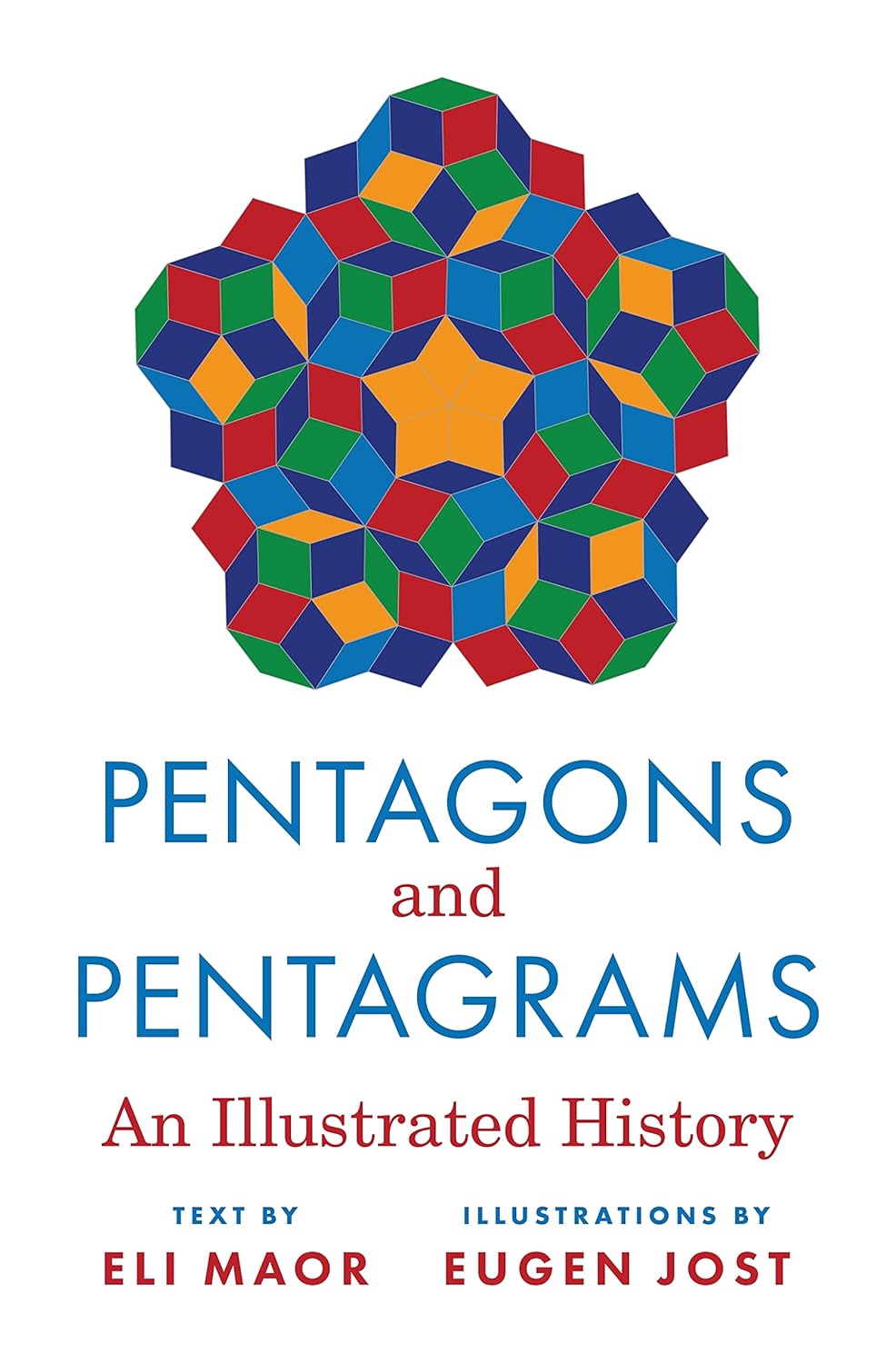
- Author: Eli Maor
- Publisher: Princeton University Press
- Publication Date: 09/27/2022
- Number of Pages: 200
- Format: Hardcover
- Price: $27.95
- ISBN: 978-0691201122
- Category: gen
[Reviewed by Frédéric Morneau-Guérin, on 02/25/2026]
Veteran historian of mathematics and gifted expositor Eli Maor has built a distinguished career around exploring single mathematical themes in depth (the number e, the Pythagorean theorem, geometric beauty, …) and tracing their cultural and intellectual reverberations across centuries. In Pentagons and Pentagrams, richly illustrated by Swiss artist Eugen Jost, Maor turns his attention to the five-sided polygon and its starry counterpart, producing an engaging narrative that is at once historical survey, recreational mathematics compendium, and meditation on mathematical interconnectedness.
The subject may appear modest: the regular pentagon and the pentagram formed by its diagonals. Yet Maor demonstrates early on that this figure, lacking the immediate symmetry of the square or the hexagon, conceals structural subtleties that have fascinated mathematicians for over two millennia. The internal web of ratios created by the pentagon’s diagonals gives rise to relationships of striking elegance and surprising depth. What seems at first glance geometrically awkward reveals itself as mathematically fecund.
Maor writes for a broad audience. The algebra and geometry required rarely exceed secondary-school level, and the exposition is consistently lucid. Equations appear sparingly and purposefully. Readers with modest technical preparation will be able to follow the arguments, while professional mathematicians, though unlikely to encounter unfamiliar theorems, will find much to appreciate in the cultural and historical texture of the account. In this respect, Maor’s approach recalls that of Martin Gardner: mathematically sound, historically informed, and animated by a contagious sense of wonder.
The narrative spans roughly twenty-five centuries. Beginning with the Pythagoreans, who are believed to have studied the regular pentagon in the sixth century BCE, Maor revisits the classical Greek geometric worldview in which mathematics was inseparable from construction. The problem of constructing a regular pentagon with straightedge and compass becomes a focal point, leading naturally to the golden ratio; the structural key not only to the pentagon but to a vast constellation of mathematical and aesthetic phenomena.
Maor treats the golden ratio not as a mystical talisman but as a genuine mathematical bridge between domains. Its appearance in the pentagon’s diagonal ratios connects geometry to arithmetic through the Fibonacci sequence, inviting readers to experience the intellectual delight that arises when disparate branches of mathematics unexpectedly converge. This interplay (between number theory, geometry, and even art) is one of the book’s recurring themes.
Beyond classical geometry, Maor explores figurate numbers (including pentagonal numbers), rotational symmetry of order five, and the filled five-pointed star sometimes called a “pentastar.” The discussion moves fluidly between mathematical argument, historical anecdote, and cultural reference. Architectural motifs, artistic symbolism, and natural forms all make appearances, reinforcing the idea that the pentagon’s significance extends well beyond the confines of formal mathematics.
One of the book’s most compelling sections concerns tilings of the plane. Regular pentagons cannot tile the plane without gaps or overlaps; a fact that opens the door to a rich and ongoing mathematical investigation into non-regular pentagonal tilings. Maor recounts the long and occasionally dramatic history of classifying such pentagons, a problem punctuated by surprising discoveries and periodic corrections. The narrative naturally leads to the aperiodic tilings discovered in the 1970s by Roger Penrose, whose “kite” and “dart” shapes, later popularized by John Horton Conway, demonstrated that non-periodic order could arise from simple geometric constraints. Maor also touches on the 2023 discovery of a monotile capable of enforcing aperiodicity, underscoring the continuing vitality of the field.
The story extends further into physics. The discovery of quasicrystals in 1982 by Dan Shechtman (a breakthrough that challenged longstanding assumptions about crystalline symmetry) provides a striking real-world counterpart to the mathematical theory of aperiodic tilings. Fivefold symmetry, long deemed incompatible with crystalline order, was suddenly observed in nature. Here, Maor’s historical arc reveals an unexpected unity: geometric curiosities explored for their intrinsic interest can later reshape scientific paradigms.
Structurally, the book is organized into nine brisk chapters interspersed with shorter interludes, followed by appendices that collect more substantial mathematical arguments. This arrangement allows general readers to maintain narrative momentum while offering technically inclined readers opportunities for deeper engagement. The illustrations play a crucial role throughout. Jost’s diagrams are clear, aesthetically pleasing, and pedagogically effective; they enhance rather than merely decorate the exposition.
If the book has a limitation, it is one inherent to its genre. Specialists will not encounter new mathematical results, and certain historical debates are necessarily simplified for narrative coherence. Yet such selectivity is appropriate for a work of this scope and intended readership.
Ultimately, Pentagons and Pentagrams succeeds in what it sets out to do: it transforms a seemingly humble geometric figure into a portal through which readers can glimpse the unity of mathematics, its historical continuity, and its unexpected connections to art, architecture, and the physical world. For educators, students, and mathematically curious readers alike, it offers both instruction and inspiration.
Frédéric Morneau-Guérin is a professor in the Department of Education at Université TÉLUQ. He holds a Ph.D. in abstract harmonic analysis.