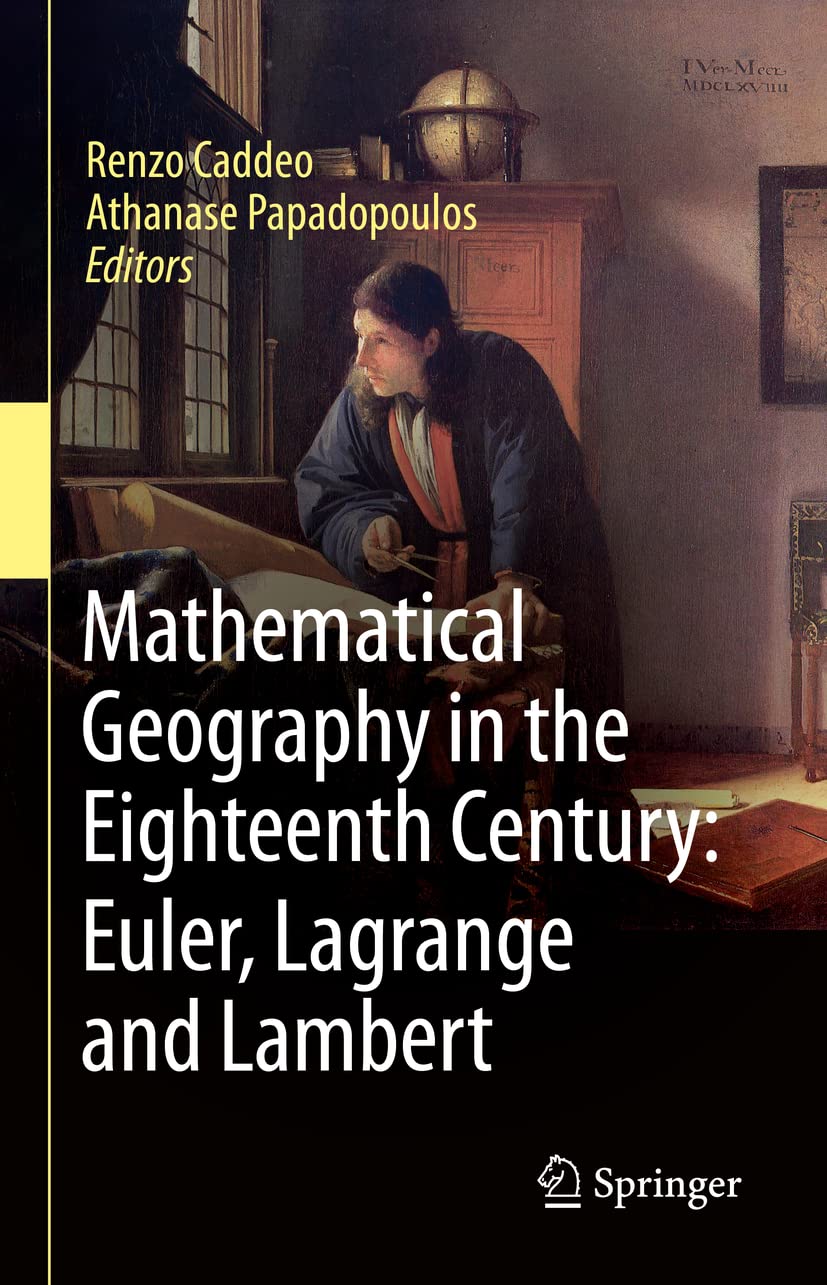
- Author: Renzo Caddeo (Editor) and Athanase Papadopoulos (Editor)
- Edition: 1
- Publisher: Springer
- Publication Date: 11/01/2022
- Number of Pages: 445
- Format: Hardcover
- Price: $129.99
- ISBN: 978-3-031-09569-6
- Category: collection
[Reviewed by Frédéric Morneau-Guérin, on 02/25/2026]
Modern mathematicians rarely consult eighteenth-century sources directly. Language barriers, obsolete notation, and dispersed arguments make such texts seem more cumbersome than enlightening, especially when contemporary expositions offer streamlined proofs and standardized terminology. Yet this convenience comes at a cost. Conceptual genealogies are flattened, priority questions become blurred, and the historical texture of ideas is largely lost.
Mathematical Geography in the Eighteenth Century: Euler, Lagrange and Lambert sets out to counter this tendency. The volume brings together carefully annotated English translations of key writings on cartography and geographical measurement, accompanied by substantial historical and mathematical essays. Its ambition is not merely archival. Rather, it aims to recover a moment when practical geographical problems – map projections, longitude determination, and the measurement of the Earth –served as powerful engines for theoretical innovation.
The book is organized in two complementary parts. The first consists of a series of interpretive chapters that trace the gradual mathematization of geography, from its early descriptive origins to its reformulation in the language of differential geometry. These essays function as guided pathways into the primary texts that follow, providing both historical context and technical commentary. The second part presents translations of four largely overlooked papers by Leonhard Euler, along with translations of related works by Joseph-Louis Lagrange and Johann Heinrich Lambert. The translations are meticulous, preserving not only semantic content but also much of the original syntactic and stylistic flavor; an editorial choice that underscores the authors’ commitment to fidelity over modernization.
One of the book’s central achievements lies in showing how cartographic questions catalyzed the development of entire mathematical frameworks. The search for optimal map projections, for instance, forced mathematicians to confront intrinsic versus extrinsic properties of surfaces, anticipate curvature-based reasoning, and invent analytic tools that would later mature into differential geometry and the calculus of variations. What emerges is a striking portrait of Euler, Lagrange, and Lambert not merely as abstract theorists, but as mathematicians deeply engaged with concrete measurement problems (latitudes and longitudes, optical distortions, and astronomical distances).
The historical essays skillfully situate these eighteenth-century contributions within a longer lineage stretching back to Greek geography and forward to nineteenth-century figures such as Gauss and Chebyshev. Particularly valuable is the careful disentangling of attribution issues. The editors demonstrate how modern secondary sources sometimes misrepresent the content or originality of Euler’s cartographic work; confusions that can only be resolved by returning to reliable translations of the originals. In this respect, the volume performs an important corrective function, reminding readers that historical accuracy requires more than repeating well-worn narratives.
From a mathematical standpoint, the commentary strikes an effective balance between accessibility and rigor. Readers with a graduate-level background in analysis or geometry will find enough technical detail to appreciate the depth of the arguments, while less specialized readers can follow the broader conceptual arc. The authors resist the temptation to retrofit eighteenth-century results into fully modern frameworks, instead allowing the ideas to unfold in their own historical idiom. This restraint is commendable: it preserves the exploratory character of the original works and highlights how much of today’s formalism was still in gestation.
If the book has a limitation, it is that its audience remains somewhat specialized. The density of historical detail and mathematical discussion may deter casual readers, and the primary texts demand patience. Yet this is hardly a flaw given the volume’s purpose. It is designed for mathematicians with an interest in history, historians of science with technical inclinations, and educators seeking deeper perspectives on the origins of familiar concepts.
Ultimately, Mathematical Geography in the Eighteenth Century succeeds in making a compelling case for returning to primary sources; not out of antiquarian curiosity, but as a means of enriching contemporary understanding. By weaving together translation, historical scholarship, and mathematical analysis, the editors offer more than a collection of documents: they provide a coherent narrative of how practical geographical problems helped shape modern mathematics.
For readers willing to engage with its materials, the book offers a rewarding experience. It illuminates a formative period in the evolution of geometry and analysis, restores neglected texts to visibility, and demonstrates that the history of mathematics, when approached with care and technical sensitivity, remains a rich source of insight.
Frédéric Morneau-Guérin is a professor in the Department of Education at Université TÉLUQ. He holds a Ph.D. in abstract harmonic analysis.