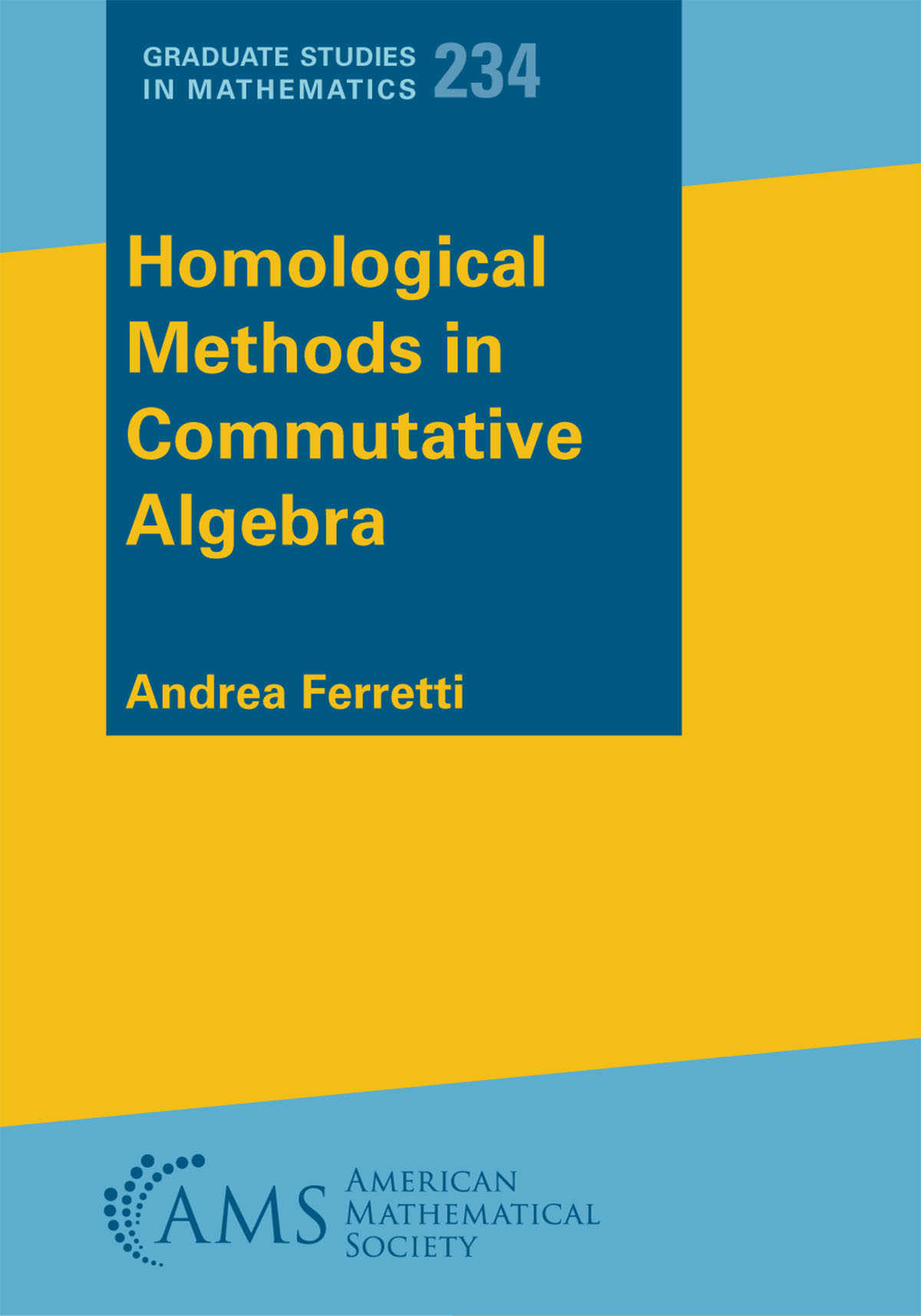
- Author: Andrea Ferretti
- Series: Graduate Studies in Mathematics, Volume 234
- Publisher: American Mathematical Society
- Publication Date: 12/04/2023
- Number of Pages: 411
- Format: Paperback
- Price: $89.00
- ISBN: 978-1-4704-7436-2
- Category: textbook
[Reviewed by Rachel Diethorn, on 03/03/2026]
This text provides a well-written and comprehensive introduction to the machinery of homological algebra and its basic applications to commutative algebra. It is well-suited for the reader who is already familiar with the basics of commutative algebra, and serves as an excellent research reference, text for self-study, or supplementary text for a graduate course in commutative algebra. The author writes in a refreshingly light and conversational tone, making it enjoyable to read and learn from. Each topic is well-motivated, with regular and enlightening references to the geometric intuition behind algebraic notions, and each chapter ends with a plethora of interesting exercises ranging from routine verifications to some very challenging and involved problems (not always in that order).
This book is not meant to be a stand-alone text for a first course in commutative algebra. It assumes familiarity with elementary commutative algebra, an appropriate prerequisite being Atiyah and Macdonald’s Introduction to Commutative Algebra or Ferretti’s Commutative Algebra. It does provide a useful appendix with some reminders of essential background material (e.g. prime avoidance, Nakayama’s Lemma, Hilbert’s Basis Theorem, integral closure, Krull dimension, and height), but the Appendix alone is not sufficient preparation for reading and understanding the text.
A unique feature of this text is that it provides in Chapters 1-4 a complete and self-contained introduction to homological algebra including basic categorical notions, derived functors, and spectral sequences, so that no prior experience with homological algebra is needed to understand the homological applications to commutative algebra in later chapters. These chapters are equally useful as a first introduction to homological algebra or as a reference for the experienced reader who wishes to jump to the commutative algebra right away. The author’s approach to proving several standard results about exact sequences in Abelian categories is also unique; rather than the common approach of using the Freyd-Mitchell Theorem to reduce to proving results about modules, the author develops a theory of subobjects to prove results in the general context of Abelian categories. This means that there is very little focus on diagram chasing in both the text and the exercises.
The remaining chapters focus on commutative algebra from a homological perspective. These chapters are remarkably well-organized and tell a clear and compelling story about the field of commutative algebra. They include both standard topics covered in comparable homological algebra and commutative algebra texts, and some interesting topics which are rarely covered in such texts. Chapters 5-6 cover the theory of free, projective, flat, and injective modules, including the notion of global dimension of rings in depth roughly comparable to Rotman’s Introduction to Homological Algebra. Chapters 7-9 cover Koszul complexes, regular sequences, as well as the hierarchy of regular, complete intersection, Gorenstein, and Cohen Macaulay rings in depth roughly comparable to Matsumura’s Commutative Ring Theory, while also including references to relatively recent work (e.g. the homological conjectures) that brings the reader closer to the research frontier. Other topics of interest, not always featured in comparable texts, include free resolutions in Chapter 5, Serre’s intersection multiplicity and Macaulay resultants in Chapter 7, the characterization of regular local rings in characteristic p due to Kunz in Chapter 8, and local cohomology, Poincare duality, and canonical modules in Chapter 10. These topics are arranged in a very sensible way and useful results are rarely relegated to the exercises for ease of reference.
Rachel Diethorn is an Assistant Professor of Mathematics at Oberlin College working in commutative algebra.