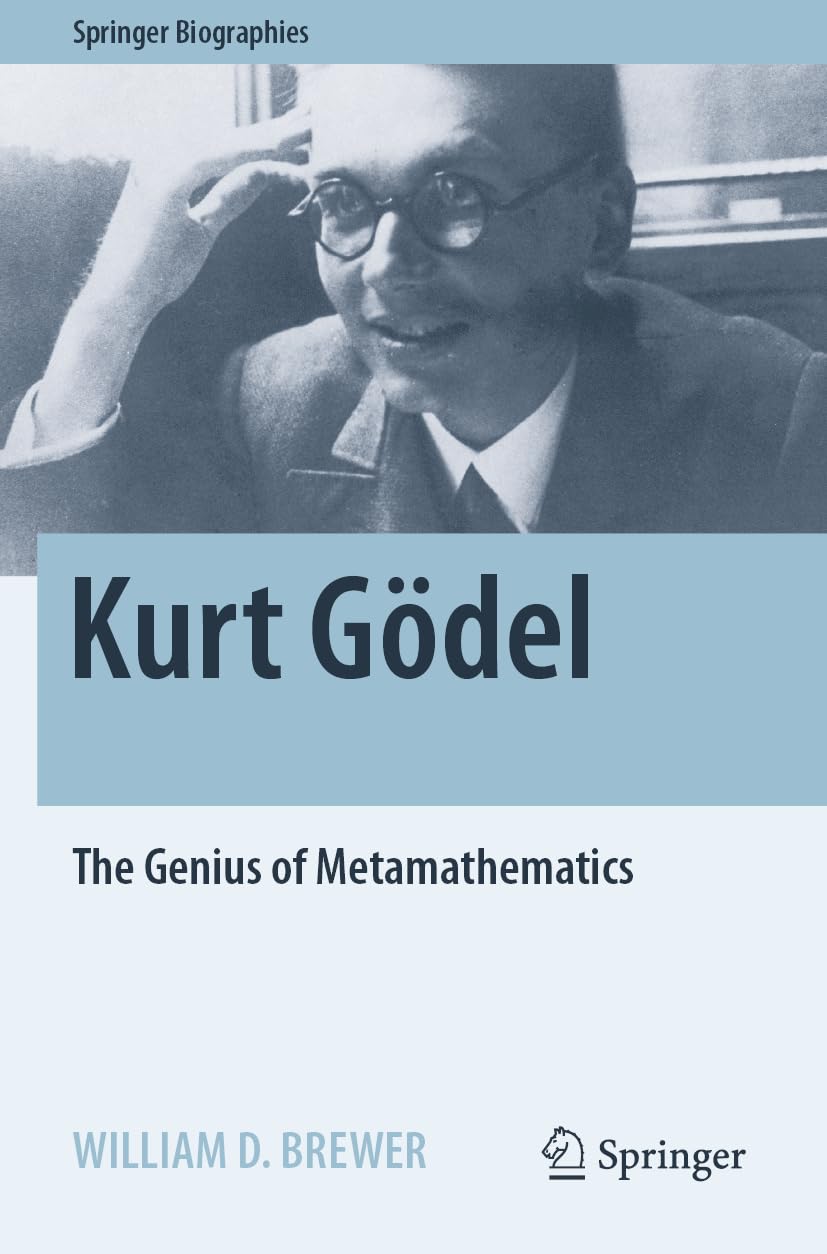
- Author: William D. Brewer
- Series: Springer Biographies
- Publisher: Springer
- Publication Date: 09/10/2023
- Number of Pages: 517
- Format: Paperback
- Price: $54.99
- ISBN: 978-3-031-11311-6
- Category: gen
[Reviewed by Frédéric Morneau-Guérin, on 02/25/2026]
Few twentieth-century logicians have acquired the cultural aura that now surrounds Kurt Gödel. While his incompleteness theorems secured his place in the foundations of mathematics soon after their publication in the early 1930s, his broader public reputation developed more gradually, fueled in part by later popular works that linked his ideas to themes of recursion and self-reference. Given the number of biographies already devoted to Gödel, one may reasonably ask what a new study can contribute.
William D. Brewer’s Kurt Gödel: The Genius of Metamathematics answers that question not by uncovering dramatic new archival revelations, but by offering a synthetic and accessible account aimed at readers with some background in mathematics, logic, or philosophy. Brewer is not a professional historian, and his book does not aspire to exhaustive archival reconstruction. Instead, it distills and reinterprets existing scholarship, supplements it with selected primary materials, and presents a coherent narrative that foregrounds Gödel’s intellectual development while giving sustained attention to his psychological and personal struggles.
The book’s central strength lies in its clear exposition of Gödel’s technical achievements. Brewer guides readers through the completeness theorem for first-order logic and then, more extensively, through the incompleteness theorems. The explanations avoid excessive formalism while preserving conceptual precision. In particular, Brewer emphasizes the crucial distinction between the internal and external viewpoints – the mathematical system and its metamathematical description – thereby clarifying the structural ingenuity of Gödel’s coding method. Readers already familiar with the results will find no surprises, but those encountering them for the first time will benefit from the careful pacing and lucid framing.
Brewer situates these achievements within the intellectual milieu of interwar Vienna. The discussions of the Vienna Circle and of Gödel’s interactions with figures such as Rudolf Carnap and Hans Hahn are informative, though selective. Brewer portrays Gödel as intellectually adjacent to logical positivism yet philosophically independent, especially in his resistance to reductionist accounts of mathematics. The book’s treatment of Gödel’s relationship with John von Neumann is particularly effective: von Neumann emerges as both an early interpreter of the incompleteness results and a steadfast advocate for Gödel’s recognition in the United States.
A distinctive feature of Brewer’s biography is the sustained attention devoted to Gödel’s psychological profile. Drawing on correspondence, recollections of contemporaries, and the famous questionnaire discovered among Gödel’s papers, Brewer examines traits that shaped both his life and work: extreme reserve, perfectionism, hypochondria, and a deep need for predictability. At times, Brewer ventures into speculative territory, cautiously suggesting that certain behavioral patterns might be consistent with what today would be described as high-functioning autism. He acknowledges the retrospective and inconclusive nature of such hypotheses, yet presents them as potentially illuminating frameworks rather than definitive diagnoses.
Whether readers find this line of inquiry persuasive may depend on their tolerance for psychological conjecture in historical biography. Some may regard it as an overreach, especially given the limitations of the available evidence. Others will appreciate Brewer’s effort to integrate Gödel’s intellectual rigor with his pronounced vulnerabilities. In any case, the discussion is handled with restraint and avoids sensationalism.
The book also devotes substantial space to Gödel’s later work in set theory and philosophy. Brewer clearly explains the constructible universe and Gödel’s proof of the relative consistency of the axiom of choice and the generalized continuum hypothesis with Zermelo–Fraenkel set theory. These chapters underscore an important theme: Gödel’s philosophical Platonism was not a rhetorical posture but a guiding conviction that informed his technical research. Brewer’s account of Gödel’s turn toward philosophy and even theoretical physics (including his work on rotating cosmological models) is concise but suggestive, and he resists the common temptation to attribute this shift primarily to Gödel’s friendship with Albert Einstein. Instead, he portrays Gödel as intellectually autonomous, even within that celebrated companionship.
The final chapters, which recount Gödel’s emigration, his long tenure at the Institute for Advanced Study, and his tragic decline, are among the most affecting. Brewer draws heavily on the testimony of Hao Wang, whose recollections provide rare glimpses into Gödel’s later years. The narrative of increasing isolation, intensifying paranoia, and eventual death by self-imposed starvation is presented soberly and without melodrama.
As a biography, Kurt Gödel: The Genius of Metamathematics does not supplant earlier, more scholarly works. It does, however, succeed as a well-organized and readable synthesis that foregrounds Gödel’s metamathematical legacy while engaging seriously with the complexities of his personality. For readers seeking a technically informed yet accessible account of Gödel’s life and thought, Brewer’s volume provides a valuable and balanced introduction.
Frédéric Morneau-Guérin is a professor in the Department of Education at Université TÉLUQ. He holds a Ph.D. in abstract harmonic analysis.