Nancy Ann Neudauer
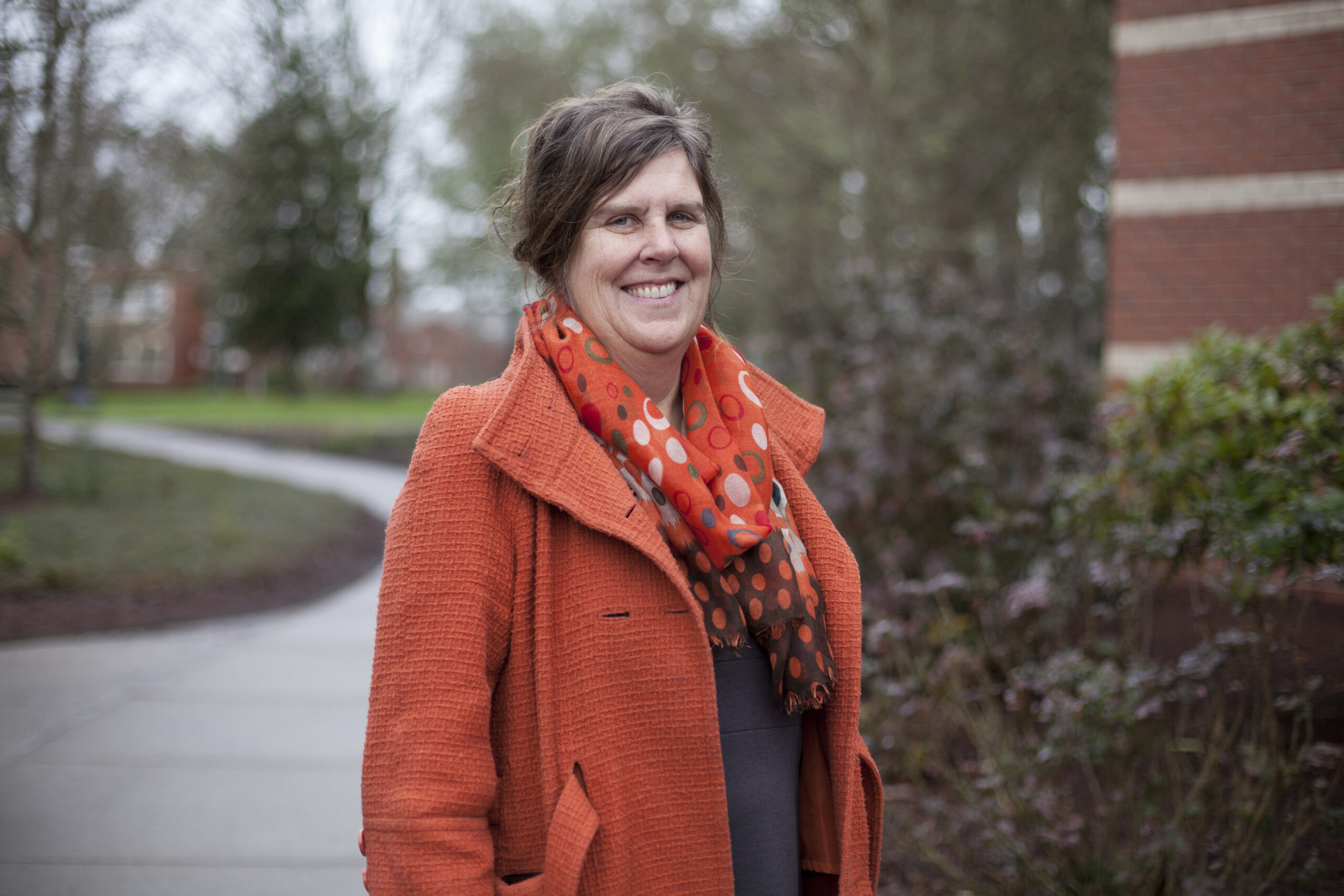
MAA Associate Secretary
Professor of Mathematics - Pacific University
Term: February 2, 2022, to June 30, 2026
This Section Visitor is available to present on the following topics at Section meetings:
Matroids You Have Known
Matroids show up several times in the undergraduate curriculum, but most of us don’t know them by name. In 1933, three Harvard junior-fellows tied together some recurring themes in mathematics, into what Gian Carlo Rota called one of the most important ideas of our day. They were finding properties of dependence in multiple mathematical structures. What resulted is the matroid, which abstracts notions of algebraic dependence, linear independence, and geometric dependence, thus unifying several areas of mathematics. The usefulness of matroids to pure mathematical research is similar to that of groups – by studying an abstract version of phenomena that occur in different realms of mathematics, we learn something about all those realms simultaneously.
We find that matroids are everywhere: Vector spaces are matroids; We can define matroids on a graph. Matroids are useful in situations that are modelled by both graphs and matrices. Yet many matroids cannot be represented by a graph nor a collection of vectors over any field. We consider the essential role of matroids in combinatorial optimization.
No prior knowledge of matroids or graphs is needed.
Models of Undergraduate Research in Mathematics
A well-mentored undergraduate research experience has been shown to be a high-impact practice, with particularly strong effects for students from minoritized groups. While common for decades amongst the lab sciences, undergraduate research has more recently been adopted and institutionalized in mathematics. I will present a few different models, and in particular, discuss the academic-year research and faculty professional development funded through the Center for Undergraduate Research in Mathematics (CURM). CURM has just been awarded its fourth five- year NSF grant to support faculty and students with mini-grants at universities and 2-year colleges throughout the United States.
CURM promotes academic-year undergraduate research in mathematics and statistics based upon a model consisting of (a) training faculty members to mentor students in research, (b) engaging students and a faculty mentor in research during the academic year at their own institution, (c) preparing students to succeed in graduate studies, and (d) advising faculty members on how to maintain consistent undergraduate research including finding resources for other funding sources.
For more information about the Section Visitor program, please visit the Section Visitor webpage.