By Erin Moss
The Robert Noyce Teacher Scholarship Program provides support for recruiting and preparing effective K-12 STEM teachers for sustained work in high-need school districts. Track 3 of the four Noyce funding tracks provides opportunities for experienced K-12 STEM teachers to develop into leaders in high-need school districts. Towson University and Morgan State University jointly run a five-year Noyce Track 3 project supporting 15 Master Teacher Fellows (MTFs) who are exemplary STEM teachers in grades 4-10 in a large urban school district. To support professional development the two institutions utilize makerspaces - collaborative workspaces that use high-and low-tech tools to create, learn, and explore. Participating in this project enables MTFs to transform their instruction and become the STEM teacher leaders of tomorrow by: (1) integrating place-based and student-centered STEM pedagogies and (2) leveraging makerspaces to introduce new opportunities for community-oriented STEM learning.
Below, Principal Investigator Dr. Sandy Spitzer and Co-Principal Investigators Drs. Diana Cheng, Kimberly Corum, and Mary Stapleton from Towson University and Dr. Vanessa Dodo Seriki from Morgan State University describe their work on this project.
How do you identify exemplary teachers that are good candidates for this leadership development opportunity?
The project leadership team worked with administrators from our Local Educational Agency, Prince George’s County Public Schools in Maryland, to recruit teachers in grades 4-10, as research suggests these years are critical in forming students’ STEM identities. Interested candidates were invited to submit an application portfolio, and we interviewed select candidates. The project team selected the final cohort based on demonstrated interest and commitment to the project and its goals, evidence of professional achievement (including positive impacts on their students’ STEM achievement), and opportunities for leadership and driving change.
You partnered with Open Works, a makerspace in Baltimore. How does this makerspace support your work in developing STEM teacher-leaders in high-need districts?
Open Works is a nonprofit makerspace dedicated to educational and economic development in Baltimore City and across the state of Maryland. Open Works offers a range of programming to support both novice and expert makers in developing the technical expertise needed to operate advanced fabrication tools and equipment. As a project partner, Open Works provided safety training for our MTFs to use the industrial sewing machines and the laser cutter, as well as a piece of equipment of their choosing. The training was supplemented by demonstrations of how these tools could be utilized in a K-12 STEM setting. MTFs then identified classroom needs and addressed them through maker-space projects later shared at the Open Works fair.
What resources are you using to support the maker-enhanced pedagogies that you are helping teachers implement in their classrooms?
We used a Capacity Building Grant to create a makerspace at Towson University and develop our MATH 626 (Using Makerspace Technologies in School Mathematics) graduate course. It builds on the theoretical frameworks of learning technology by design and technological pedagogical content knowledge as teachers learn about emerging technologies for integration in their own teaching.
Through the Towson University Center for STEM Excellence (TUCSE), we were able to tap into existing resources. The Maryland HiTech Loaner Lab provided teachers with classroom sets of Ozobots, making it easier for them to sustain innovative practices across a variety of school settings.
What are some pleasant surprises you and your team have experienced in your work with this project?
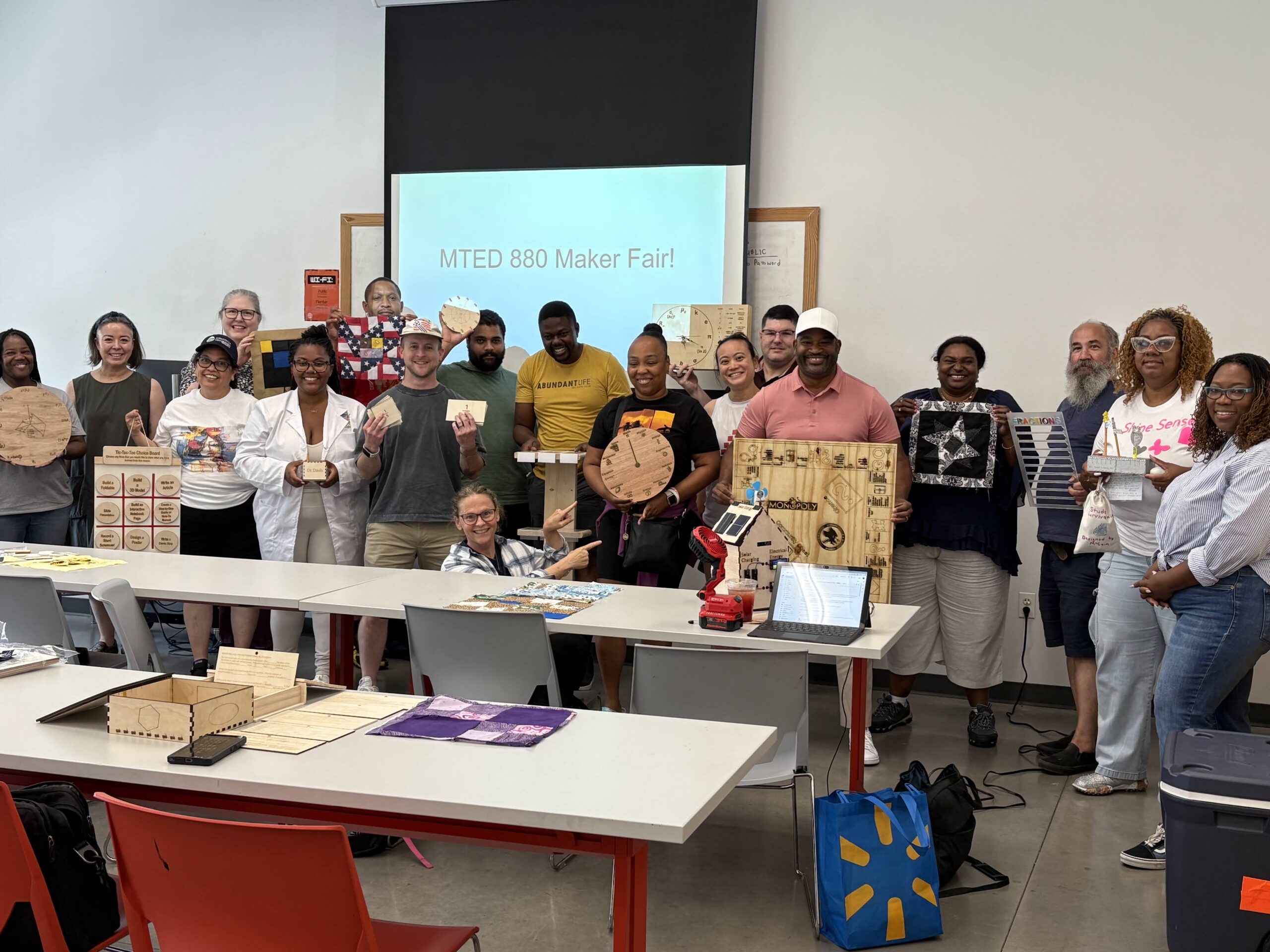
The MTFs’ Maker Fair in Summer 2025 has been one of my highlights so far. While some of our MTFs brought prior expertise with making to the project, operating advanced fabrication equipment was a new (and intimidating) experience for most of our teachers. Yet, they were able to lean on each other as a learning community to bring to life a variety of classroom tools that they designed and made themselves, ranging from classroom manipulatives and teaching tools to classroom furniture.
–Kim Corum
Seeing how our MTFs enact the role of a Learning Partner has been joyful. They have begun shifting from primarily thinking about refining their own teaching practice to supporting the growth of educators regionally, nationally, and even internationally. Some of the conferences in which our MTFs have presented within the past calendar year include the Noyce Summit, Maryland Makerspace Meetup, MathFest, Maryland Council of Teachers of Mathematics conference, National Science Teachers’ Association conference. We also became part of the Northeast Noyce Professional Learning Network led by University of Rochester faculty, which has provided our project with additional ways to disseminate our work. Over half of our MTFs traveled to the Boston regional conference to present. One MTF’s connection with theTeacher Leader Cadre Program provides an opportunity to offer a forthcoming in-person local learning institute on our campus.
–Diana Cheng
Learn more about NSF DUE 2243461, 2243462
Full Project Name: Making STEM Matter: Transforming Learning through Teacher Leadership, Justice-Centered Pedagogy, and Makerspace Technology
Abstract: https://www.nsf.gov/awardsearch/showAward?AWD_ID=2243461&HistoricalAwards=false; https://www.nsf.gov/awardsearch/show-award/?AWD_ID=2243462&HistoricalAwards=false
Project Contacts: Dr. Sandy Spitzer, PI; sspitzer@towson.edu and Dr. Diana Cheng, Co-PI; dcheng@towson.edu

Erin Moss is a Co-Editor of DUE Point and a Professor in the Department of Mathematics at Millersville University